Grip Socks for Tennis: Court Performance & Stability
Grip Socks for Tennis: Stability, Comfort, and Better Footwork Under Pressure
Tennis is a sport of constant acceleration and deceleration: split steps, lateral shuffles, sudden stops, and explosive first steps. In that environment, traction is not only about the outsole. It is also about what happens inside the shoe, where small amounts of foot movement can subtly affect balance, confidence, and efficiency.
This article explains how grip socks work, why some tennis players feel a performance difference, and how to choose the right pair for your surface, footwork style, and sweat conditions. The goal is not hype, but practical sports science and team-ready guidance. If you have ever felt your foot slide inside your shoe during a wide push or hard brake, this is for you.
How grip socks work inside a tennis shoe
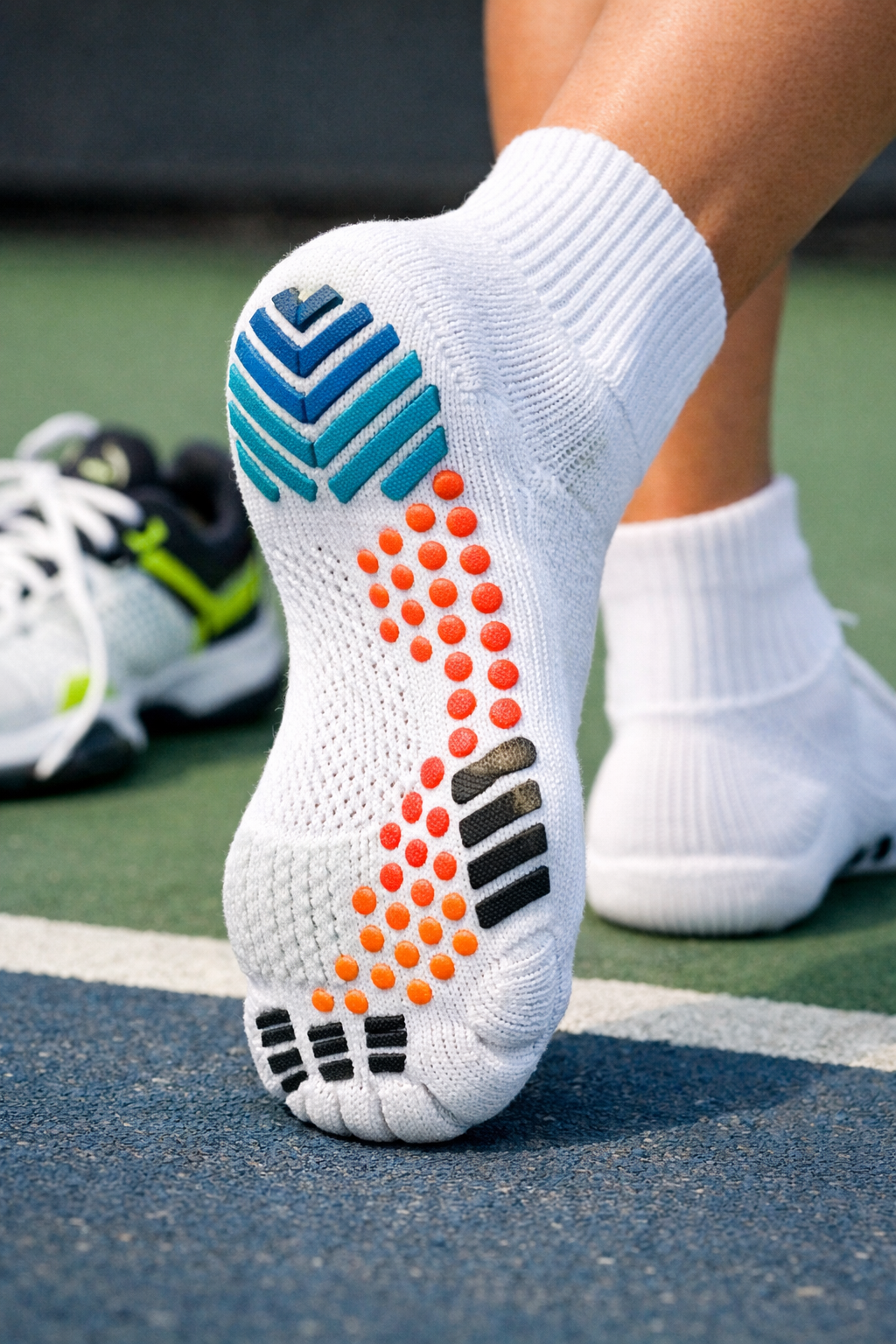
Most athletic socks are designed to be comfortable and breathable, but they can allow a small amount of sliding against the insole. That in-shoe movement is easy to miss until you start changing direction at full speed. Grip socks add patterned grip zones (often on the bottom and sometimes around the foot) to reduce micro-slippage when you plant, cut, or recover.
Think of it as improving the “connection” between foot and shoe. When the foot stays more stable, you may get a more locked-in feel during lateral pushes and quick transitions. For many players, that can translate to more predictable foot placement and better control during high-intensity points.
Why micro-slippage matters in tennis
Even slight movement inside the shoe can change mechanics at the exact moment you need precision. If the foot slides forward during braking, the toes often tense to stabilize. That muscular “grip” can waste energy over time and may contribute to fatigue late in sets.
Less internal slip can support cleaner push-offs, especially during wide recoveries and aggressive direction changes. Stability is also a confidence factor: players tend to commit more fully to a plant step when they trust their base. That is relevant for both individual athletes and teams training for consistent execution under pressure.
Are grip socks good for tennis
For many players, yes, especially if your game includes frequent lateral movement and abrupt stops. Baseliners who defend side-to-side, returners who explode on the first step, and doubles players reacting at the net often notice the benefit first. The biggest “aha” moment usually comes on hard courts, where braking forces are sudden and your shoe must resist quick changes in momentum.
That said, grip socks are not a universal answer. They work best when the shoe fits well and when the sock’s material manages moisture effectively. If your shoes are too long or too wide, grip can reduce sliding but may not fully fix instability caused by poor fit.
Key takeaway: Grip socks can improve in-shoe stability, but the full performance benefit shows up when shoe fit, sock fit, and moisture control all work together.
Performance benefits tennis players often report
Different athletes notice different changes, and the effects can be subtle rather than dramatic. Still, the patterns are consistent across many competitive environments. When traction inside the shoe improves, movement tends to feel more controlled and repeatable.
- More stable planting: A firmer feel when stopping, cutting, or loading the outside leg on wide balls.
- Cleaner transitions: More confidence moving forward to the net and changing directions in small spaces.
- Better late-match consistency: When fatigue rises, stable foot feel can help preserve technique and timing.
- Improved court feel: Some players describe a more “connected” sensation during push-offs and split steps.
Hard court versus clay court expectations
On hard courts, stopping forces are high, and internal foot slip can feel amplified during sharp brakes. Grip socks can make those stops feel more controlled by reducing the foot’s tendency to shift on the insole. For aggressive movers, that can be meaningful over long matches or training blocks.
On clay, movement often includes intentional sliding for some athletes. The goal is not maximum stickiness against the court surface, but predictable stability inside the shoe while you execute your technique. Grip socks can still help by reducing unwanted internal slip without interfering with how you slide on clay, assuming the shoe and outsole support that style.
Comfort and blister prevention: what grip can and cannot do
Blisters are primarily a friction problem, and friction increases when skin, sock, and shoe surfaces rub repeatedly under pressure. If your foot slides inside your shoe, friction rises at common hotspot areas like the heel, ball of the foot, and toes. By reducing in-shoe movement, grip socks may reduce friction and help some athletes experience fewer hotspots.
However, grip alone is not a cure-all. Moisture matters because damp fabric can increase friction and soften the skin, which makes blistering more likely in sweat-heavy sports like tennis. The sock’s fabric, thickness, and drying speed can be just as important as the grip pattern.
Moisture management checklist for tennis
- Choose wicking materials: Look for fabrics that move sweat away from the skin and dry quickly.
- Consider cushion placement: Cushioning under the heel and forefoot can help with repeated impacts without making the fit bulky.
- Match sock thickness to shoe volume: Too thick can cramp the foot, too thin can increase pressure and rubbing.
- Rotate pairs during long sessions: A dry change at practice can reduce friction accumulation.
For general blister education and prevention strategies, athletes can reference resources like the American Academy of Dermatology guide to blisters. Pairing those fundamentals with stable sock and shoe choices is often the best approach.
What to look for in grip socks for tennis
Not all grip socks are built for the same demands. Tennis includes repeated forefoot loading, lateral pushes, and hard braking, so construction details matter. The best option is the one that supports your movement patterns without changing shoe fit in an unpredictable way.
- Grip placement in tennis load zones: Prioritize traction under the heel and forefoot where braking and push-off forces concentrate.
- Secure cuff that does not bunch: Bunched fabric can create pressure points and distract during play.
- Arch support or mild compression: Some athletes like the supportive feel and reduced fabric migration.
- Reinforced toe and heel: Useful for frequent training and high-mileage footwork sessions.
A simple fit test before match day
Do not wait for competition to experiment. Put the socks on, lace your shoes as you would for a match, and perform tennis-specific movements: split steps, two hard lateral pushes each direction, and two aggressive stop-start sprints. If you feel your toes clawing for stability or your heel lifting, reassess sizing and shoe fit.
Team and program considerations: consistency matters
For teams, small equipment differences can create big variation in feel, especially when athletes share similar shoes but different socks. If a program is exploring grip socks broadly, aim for consistent sizing, uniform grip patterns, and athlete feedback across positions and playing styles. The objective is standardization that supports performance, not a change that makes some athletes feel “too stuck” or alters shoe fit.
Some teams choose to use custom socks for uniformity and identity, but the performance priority should still be construction and fit. Companies such as Nextwave Socks may offer custom options, and if teams go that route, it is worth sampling with a small group first to confirm that the sock complements the shoe and surface demands.
Conclusion: a practical tool for controlled movement
Grip socks can be a useful performance tool in tennis because they address a real issue: foot movement inside the shoe during high-intensity cuts, stops, and transitions. Many players experience improved stability, more predictable planting, and potentially fewer hotspots when friction is reduced. The biggest benefits tend to show up for athletes who move explosively laterally, especially on hard courts.
The smart approach is to treat grip socks as part of a system: shoe fit, sock fit, cushioning, and moisture management all work together. If you are experimenting, test them in practice, evaluate how they feel on your primary surface, and pay attention to whether fatigue changes your footwork late in sessions. Share your experience with teammates, and compare notes to find what improves consistency for your group.
If you want to explore more team and athlete resources, visit are grip socks good for tennis and share what footwear topics you would like covered next.
Grip that’s scientifically proven.
Join 23,197+ athletes. Free worldwide shipping, up to 44% off the latest drop.
Shop grip socks →