
Are Grip Socks Banned in Football? League Rules Explained
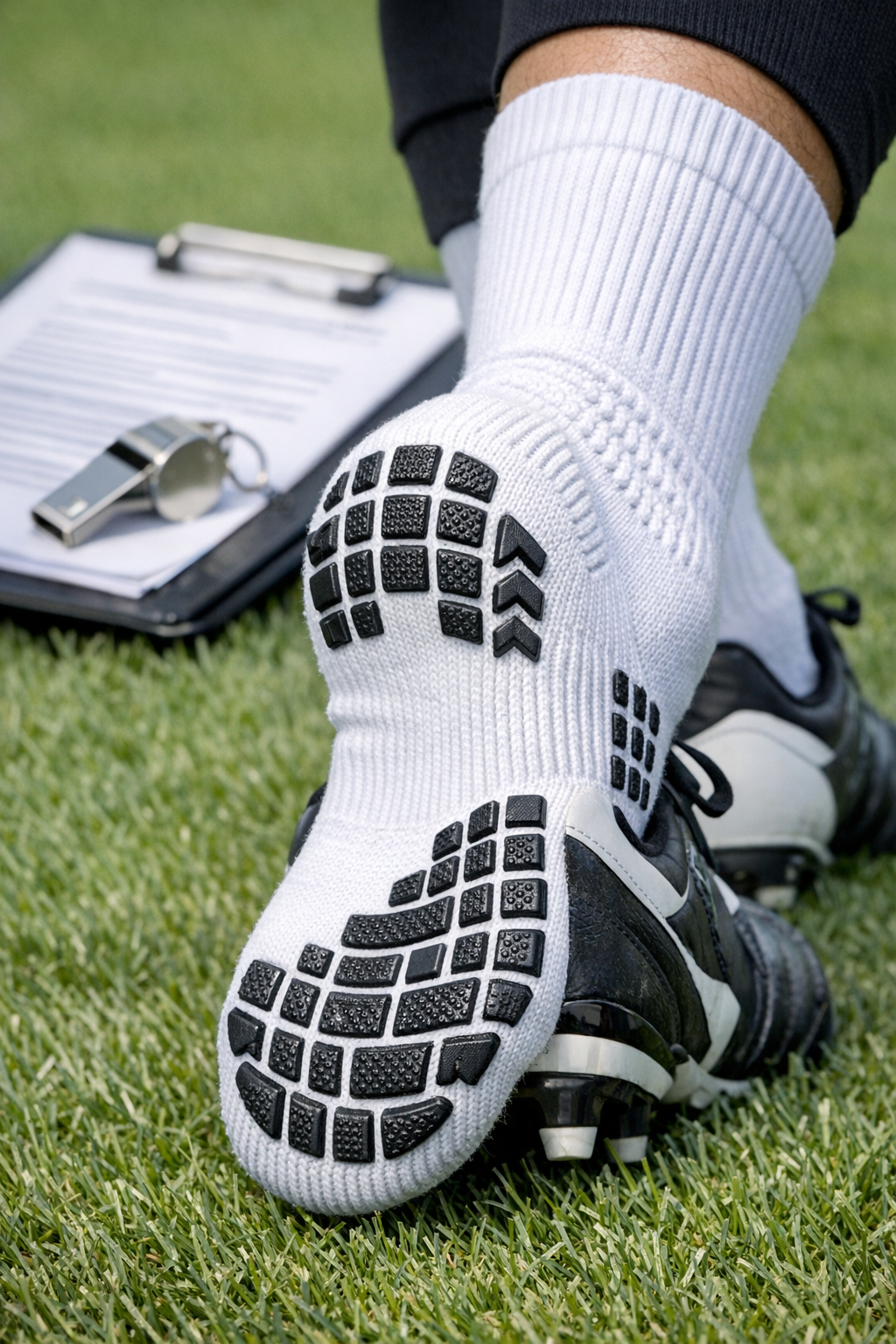
Grip Socks and Soccer Rules: How to Stay Compliant and Game-Ready
Grip socks have become a common piece of performance gear for athletes who want more in-boot stability, cleaner footwork, and fewer distractions during play. But one question keeps coming up for teams and individual players: can you actually wear them in official matches?
This guide breaks down how grip socks are typically treated under soccer rules, where problems usually occur, and how to avoid match-day issues without sacrificing performance. The goal is simple: help you get the benefits while staying compliant with your league, your kit requirements, and the referee’s expectations.
How soccer equipment rules get enforced
Most confusion happens because “the rules” are not just one document. Equipment compliance is usually enforced at three levels, and the strictest one in your situation is the one that matters most.
Understanding these layers helps you predict what will be allowed and what will be flagged during inspection.
Level 1: The Laws of the Game (baseline)
The Laws of the Game set the baseline for required equipment: jersey, shorts, socks, shin guards, and footwear. They also give referees authority to decide if something is dangerous or non-compliant. Grip socks are not specifically listed as illegal, so they are usually treated like an accessory item.
The practical takeaway is that grip socks are generally fine if they do not create a safety risk and they do not compromise required equipment like shin guard coverage.
Level 2: League and competition rules (often stricter)
Many leagues add uniform policies that focus on consistent appearance, approved kit colors, and limits on visible undergarments. In stricter competitions, anything visible that does not match the team kit can be flagged even if it is safe.
This is where most “it was fine last week but not today” stories start, especially in tournaments with formal pre-match checks.
Level 3: Referee match-day discretion (the final gate)
Even if your equipment seems compliant on paper, the referee has final say on what is allowed in that match. Referees are responsible for player safety and for ensuring the match is played under the competition rules.
If your grip sock setup looks like a sock modification, creates exposed edges, or distracts from uniform consistency, you are more likely to be asked to change it before kickoff.
Are grip socks banned in soccer
Grip socks are not universally banned in soccer. In most settings, they are allowed if they function like a standard under-sock or sock liner and do not conflict with uniform rules.
Where players get into trouble is not the concept of grip socks, but the way they are worn, how visible they are, and whether the team sock has been altered to show them off.
What usually causes grip socks to be disallowed
Most enforcement issues come down to kit appearance, sock integrity, and safety. If you want to avoid being stopped at inspection, it helps to know the most common red flags.
- Visible mismatched colors that do not match the team sock or league requirements for uniform appearance
- Large or contrasting logos that break competition branding rules or look like non-approved kit
- Cut holes in the team sock to expose grip material, which can be considered an illegal modification
- Loose tape or protruding material that a referee views as a snagging hazard or distraction
- Compromised shin guard coverage if socks are cut too low or do not fully cover the guard
Key takeaway: Grip socks tend to be accepted when they are invisible under the official sock, and questioned when they change the outer look of the kit or the structure of required equipment.
Uniform rules: the biggest source of confusion
Uniform policies vary widely. Some competitions focus heavily on visual consistency across the team, while others focus mainly on safety and required equipment coverage.
Knowing which type of league you are in will tell you whether you should prioritize “hidden and simple” or whether “neat and matching” is enough.
If your league is strict about matching the registered kit
In these leagues, the outer sock often must match the official team design and color. Any visible liner, grip sock, or additional material can be flagged if it changes the overall look.
The safest setup is a liner-style grip sock worn fully underneath the official team sock, with no cut-outs and minimal visible elements.
If your league is mostly focused on safety and coverage
In more flexible leagues, referees often care most about whether shin guards are fully covered and whether the equipment is secure. If everything looks tidy and consistent, grip socks rarely get attention.
Even then, avoid extremes like oversized external grips or sloppy tape jobs, since “unsafe” is a judgment call on match day.
Performance and sports science: why players use grip socks
From a performance perspective, the idea is straightforward: reducing foot slip inside the boot can improve perceived stability during acceleration, deceleration, and cutting. Less internal movement can also reduce friction hot spots for some athletes.
That said, grip socks are not a substitute for good boot fit, appropriate stud selection, and well-managed training load. They are one tool in a larger performance system.
Sock modifications: what to know before you cut anything
Cutting holes in socks for calf comfort has become common, but some competitions view altered socks as non-compliant. Others allow it but expect uniformity across the squad.
If your league is strict, avoid cut-outs entirely and use a grip liner under the team sock. If your league is flexible, keep any modifications neat, minimal, and consistent across players, because inconsistency attracts scrutiny.
A compliance-first checklist for teams
If you manage equipment for a team, your goal is to remove ambiguity before match day. A simple standard can prevent last-minute changes that disrupt routines and focus.
- Read your competition equipment rules and note any language about sock color, visible undergarments, and alterations.
- Standardize the approach across the roster: same color, same style, same visibility rules.
- Prioritize hidden grip setups by default, especially for away matches or tournaments with stricter inspections.
- Keep branding minimal and avoid high-contrast elements that draw attention.
- Do a pre-match kit check to confirm shin guards are fully covered and tape is secure.
What to do if you are unsure
If you are uncertain about whether your grip socks are compliant, clarify before kickoff day. Ask your coach, equipment manager, or team administrator to verify the league’s position, and when possible, confirm with match officials ahead of time.
You can also reference official guidance from the sport’s governing bodies, starting with the IFAB Laws of the Game: The Players’ Equipment. For competition-specific rules, check your league or federation’s website, such as U.S. Soccer governance resources if you play in the United States.
Keep reading: our guide to FIFA rules on grip socks, or see football grip socks.
Conclusion: performance gear works best when it is rule-proof
Grip socks are usually allowed in soccer, but permission depends on competition rules, visibility, and how they integrate with the team kit. The safest route for most athletes is a liner-style grip sock worn under the official sock, with no cut-outs, no mismatched colors, and no distractions for the referee.
When you treat compliance as part of performance preparation, you reduce the risk of last-minute equipment changes and keep attention where it belongs: on the game. If your team is exploring uniform-consistent options, some suppliers such as Nextwave Socks can support custom approaches, but the priority should always be matching competition requirements first.
If you have questions about your league’s uniform rules or want to compare notes on what officials commonly allow, share your experience and explore more here: are grip socks banned in soccer.
Grip that’s scientifically proven.
Join 23,197+ athletes. Free worldwide shipping, up to 44% off the latest drop.


