Where to Buy Grip Socks: Best Athletic Socks 2024
Grip Socks in 2024: How to Buy the Right Pair for Real Performance
Grip socks have gone from a niche training add-on to a serious piece of performance gear for athletes who depend on sharp cuts, hard stops, and controlled footwork. The reason is simple: traction is not only about your shoe’s outsole, it is also about what happens inside the shoe. If your foot slides even slightly, you lose efficiency, confidence, and sometimes stability.
This guide breaks down where to shop, what quality actually looks like, and how to choose grip socks for your sport. It is written for individual athletes who want reliable traction and for coaches and team managers who need consistent sizing, repeatable reorders, and optional customization without guesswork.
Why grip socks matter for athletic performance
In sports science terms, grip socks aim to reduce internal shear, the small sliding forces between your foot, sock, and insole during movement. Lower internal slip can help you feel more “locked in,” especially when decelerating, changing direction, or landing from jumps. The goal is not just more friction, but more consistent friction through a full session.
Just as important, grip socks work as a system with fit and moisture control. Sweat can act like a lubricant inside the shoe, and a sock that holds moisture or bunches up can cancel out even an aggressive grip pattern. That is why shopping by “non-slip” labels alone often leads to disappointment.
Where to get grip socks?
Finding high-performance grip socks in 2024 is less about hunting for a single “best” option and more about choosing suppliers that are transparent about materials, construction, and intended use. Below are the most common places athletes and teams shop, plus what each channel does well.
Specialty sports retailers (online and in-store)
Specialty retailers tend to curate performance-focused options, which usually means fewer random multipacks and more product detail. You are more likely to see information on yarn blends, cushioning, compression level, and sport-specific use for soccer, basketball, football, volleyball, and training. That clarity makes it easier to compare socks based on function, not marketing.
- Best for: athletes who want vetted options and clear specs
- Watch for: limited customization and limited size runs depending on the retailer
Direct-to-brand websites
Buying direct is one of the easiest ways to verify what you are getting, including grip placement, density, and durability notes. These sites often include care instructions and sizing guidance that is more precise than generic listings. It is also where you will most often find custom grip sock options for teams, including logo placement and color matching.
If your club is exploring customization, subtle, performance-led suppliers such as Nextwave Socks may offer clearer communication around grip construction and reorder consistency than general marketplaces. The key is not the name on the sock, but the transparency around how it is built and how it will hold up.
- Best for: verified specs, newest versions, broader sizing, customization
- Watch for: shipping timelines and minimum order quantities for custom work
Team dealers and uniform suppliers
If you are managing a roster, a team supplier can simplify the logistics. They can coordinate size runs, handle reorders, and align delivery with uniform timelines. This channel is often less about browsing and more about reliable fulfillment across an entire season.
- Best for: coaches, kit managers, and clubs who need repeatable ordering
- Watch for: fewer “test pairs” and sometimes less detail on performance specs
Marketplaces (use with caution)
Large marketplaces are convenient, but quality is inconsistent. Many listings promise “elite grip” while skipping the details that actually predict performance, such as grip bonding method, yarn blend, and manufacturing consistency. Those shortcuts often show up later as grips peeling, heel structure collapsing, or traction fading after a few washes.
- Best for: quick replacements when you know exactly what you are buying
- Watch for: vague descriptions, copied photos, and short-term reviews only
What “quality” means in grip socks
Not all grips are created equal, and the “best” sock is usually the one that stays stable through your hardest movements and still performs after repeated laundry cycles. Use the checkpoints below as a quick quality filter when shopping online or evaluating samples for a team order.
Grip layout and density
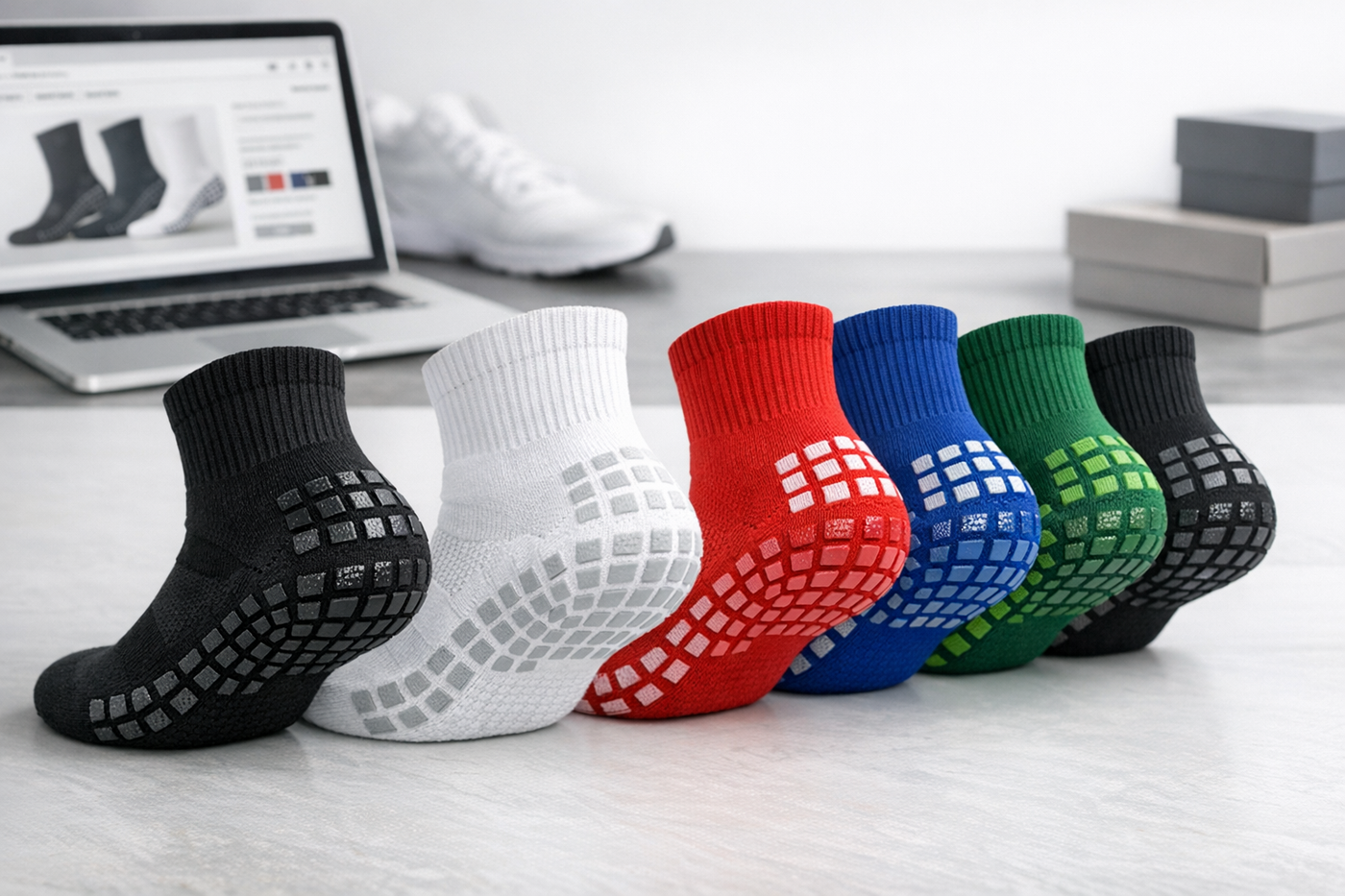
High-performance designs usually place grip zones under the forefoot and heel, where most slipping occurs during cuts and stops. Patterns should support lateral movement, not just straight-line running. Overly sparse grips can feel inconsistent, while overly bulky grips can feel distracting or create hot spots.
Grip durability over time
Durability is where many socks fail. Better grips are bonded or integrated in ways that resist cracking and peeling through wash cycles. When reading reviews, prioritize feedback from athletes who have worn them for weeks, not first-impression posts after one session.
Yarn blend and moisture control
Moisture management is traction management. Breathable synthetic blends, often using nylon or polyester with elastane, tend to move sweat away and dry faster. Purely cotton options often retain moisture, which can increase internal slip and reduce the “locked-in” feel during long sessions.
Fit and lock-in features
A great grip pattern cannot compensate for a sock that rotates. Look for a secure arch band, a heel pocket that holds shape, and a cuff that stays put without cutting off circulation. Reinforced toe and heel zones also matter for teams, where repeated use quickly reveals weak construction.
Compression and feel
Some athletes like light compression for stability and reduced fatigue, while others prefer a more relaxed fit for comfort. There is no universal best, but there is a best match for your sport, position, and personal preference. If you are buying for a full team, consider offering two thickness or compression options when possible.
Key takeaway: Real traction comes from the full system: stable fit, sweat control, and grips that stay effective after repeated wear and washing.
How to choose grip socks for your sport
Different sports stress the foot-sock-shoe system in different ways. Use these sport-specific priorities to narrow your choices and avoid paying for features you will not benefit from.
Court sports (basketball and volleyball)
Court athletes need traction for stop-start movement, repeated jumps, and quick lateral transitions. Prioritize strong forefoot grip, responsive cushioning, and breathability to manage heat buildup. A secure heel pocket is especially important for repeated landings where micro-slippage can irritate skin.
Field sports (soccer, football, and lacrosse)
Field athletes often wear grip socks under a separate team sock, so the fit must stay secure through long sessions. Look for sweat management, a stable arch band, and grips that maintain traction even when damp. If doubling socks, pay close attention to thickness so your boots do not feel overly tight.
Training and gym work
Training demands versatility: lifting, sled work, agility drills, and conditioning. A balanced grip pattern, comfort-focused cushioning, and reinforced toe and heel zones usually deliver the best all-around value. Avoid extremes unless your training is highly specialized.
Custom grip socks: what teams should consider
Customization is not just about a logo. For teams, the performance and logistics details determine whether custom socks become a smooth part of your season plan or an ongoing headache.
- Minimum order quantities and lead times: plan for preseason delivery and potential mid-season reorders.
- Color matching and design clarity: simple, high-contrast designs tend to look best across every size.
- Consistent sizing: ask for a true size run so athletes get the right fit and consistent compression.
- Repeatability: confirm the supplier can replicate materials, grip placement, and colors on future orders.
Smart buying tips that protect performance
Small decisions affect long-term traction and comfort. These practical steps help athletes avoid common mistakes and help teams avoid costly bulk-order surprises.
- Follow care instructions: washing and drying methods can significantly impact grip longevity.
- Read reviews for long-term wear: look for mentions of heel blowouts, shrinking, and grip peeling after multiple washes.
- Test one pair first: if possible, trial a single pair before committing to a team order.
- Match sock thickness to footwear fit: thicker socks can change boot or shoe volume and alter perceived traction.
Conclusion: buy for the system, not the label
In 2024, the best grip socks are the ones that perform as part of a complete traction system: the right fit, the right moisture control, and grips that stay effective over time. Where you shop matters because transparency matters, especially when performance and durability are non-negotiable. Whether you are an individual athlete dialing in footwork or a team planning a season’s worth of kit, prioritize clear specs and repeatable quality.
If you have found a feature that makes a noticeable difference in your sport, share it with your teammates or drop your thoughts in the comments. To explore more information on team ordering and performance sock options, visit where to get grip socks?.
Grip that’s scientifically proven.
Join 23,197+ athletes. Free worldwide shipping, up to 44% off the latest drop.
Shop grip socks →