Are Grip Socks Legal in Football? Match Day Rules
Grip Socks on Match Day: What’s Legal, What Gets Flagged, and How to Stay Compliant
Grip socks have moved from a niche accessory to a common part of modern soccer kit, showing up in professional locker rooms and youth tournaments alike. Players often wear them for a more secure “locked-in” feel inside the boot, especially during quick changes of direction. The big question teams and athletes keep asking is simple: are they allowed when the whistle blows?
This guide explains what the Laws of the Game do and do not say, why your league rules matter most, what referees look for during inspection, and how to set up grip socks in a way that supports performance without risking a last-minute kit issue. The goal is clarity, not hype, so you can focus on playing.
What the Laws of the Game say (and don’t say)
Under IFAB’s Laws of the Game, socks are part of the required equipment, along with a jersey, shorts, shin guards, and footwear. However, the laws do not specifically mention grip socks as a separate item. That matters because it means grip socks are not “illegal” by default simply for having grip elements.
In practice, legality tends to be judged through two lenses: does it comply with the competition’s kit rules and is it safe? If a grip sock setup doesn’t create a hazard and still meets uniform requirements, it is typically allowed.
If you want to see the global framework referees work from, review the official equipment section via IFAB’s Laws of the Game: The Player’s Equipment. Your local league may add stricter requirements on top of this baseline.
Are grip socks legal in soccer?
Most of the time, yes, grip socks are legal to wear in soccer. The phrase “legal” on match day usually means you passed the referee’s pre-match inspection and complied with your competition rules. Since IFAB does not explicitly ban grip socks, decisions typically come down to color, uniform consistency, and whether the setup looks safe and tidy.
The most important takeaway is that your league, tournament, and club policies can be more restrictive than the global laws. That is why one team can wear grip socks without a second glance in one competition, while another gets told to change before kickoff in a different event.
The real deciding factor: competition and team kit rules
Most restrictions around grip socks come from competition regulations and team standards, not referees “going rogue.” Many leagues include uniform policies to keep teams visually consistent, simplify officiating, and avoid kit confusion between opponents.
Common rules that can affect grip socks include the following:
- Sock color requirements: Some leagues require a specific team color for socks, including strict home and away variants.
- Uniform consistency: Teams may require the entire squad to match, which can limit visible under-socks.
- Branding limits: Certain competitions restrict visible logos beyond a standard manufacturer mark.
- Tape and alterations: Cutting socks, adding heavy tape, or changing the appearance of the kit can lead to a correction request.
For organized teams, it helps to treat socks like any other piece of match kit: align expectations early, choose one approach, and confirm it fits the competition’s rules. Even if players source socks independently, setting a standard avoids inconsistent looks and pre-game stress.
Layering, cutting, and “sock-in-sock” setups
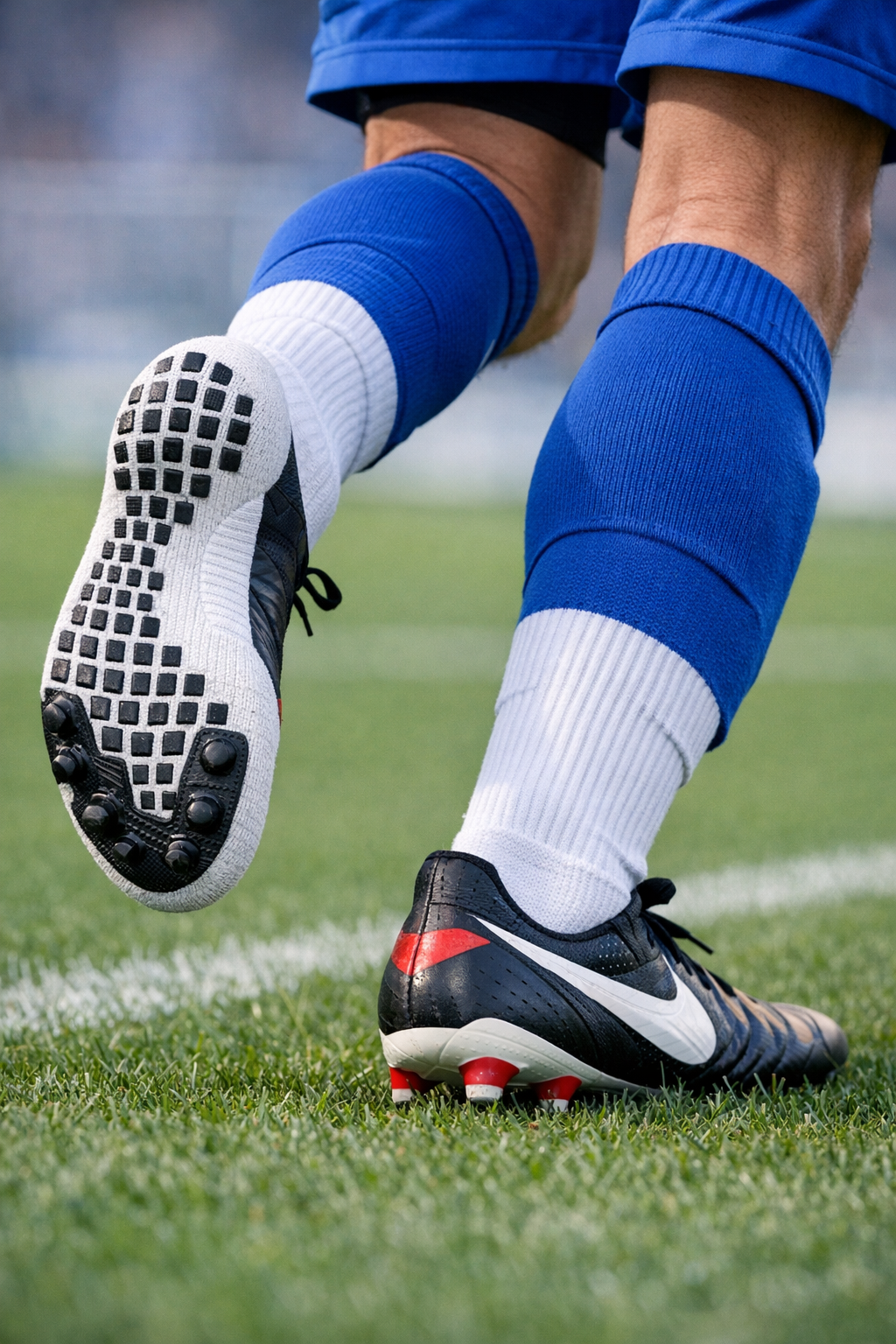
A common match-day solution is wearing grip socks underneath, then pulling official team socks over the top. This “sock-in-sock” setup lets athletes keep a clean team look while still using a performance sock next to the skin. It is also where most problems arise, especially when modifications become noticeable.
When layering usually works smoothly
Layering is often accepted when the outer sock clearly looks like the official kit sock and the shin guards remain fully covered. If the grip sock stays mostly hidden and the overall appearance is consistent across the team, it rarely draws attention.
From a sports science perspective, the goal is to reduce internal foot movement without introducing bulk. If the layered setup changes boot fit significantly, it can increase pressure points and hot spots, so athletes should test it in training rather than on match day for the first time.
Where players run into trouble
Issues tend to appear when the outer sock is cut, bunched, or taped heavily, or when the under-sock becomes the visible “game sock.” Many competitions interpret heavy modifications as a uniform alteration, even if the intent is comfort or circulation.
- Cutting outer socks can violate “no modification” policies in some leagues and clubs.
- Exposed under-socks can be flagged if the visible sock color does not match the required kit.
- Loose material and bulky tape may be considered a snag risk or may interfere with shin guard coverage.
What referees typically check on match day
Referees are not judging whether grip socks “work.” They are checking compliance, safety, and whether equipment meets the basic standards of the competition. Their goal is to prevent avoidable injuries and ensure both teams are properly equipped.
Expect pre-match inspection to focus on these points:
- Color and uniform compliance: Does the visible sock match team requirements and avoid confusion with the opponent?
- Shin guards covered: Socks must cover shin guards as required by the Laws of the Game and most competition rules.
- No hard or sharp elements: Nothing should create a risk to the player or opponents.
- No unsafe modifications: Excessive cuts, dangling material, or anything that could catch a boot or stud may be questioned.
Key takeaway: If your grip sock setup looks clean, consistent, and safe, it is far less likely to be challenged.
How to stay compliant without giving up performance
High-performance habits include reducing friction problems, maintaining comfort over 90 minutes, and minimizing distractions before kickoff. The best approach is to make your grip sock setup boring from an officiating standpoint: it should look like standard kit and pass inspection quickly.
- Confirm rules early: Check your league or tournament rulebook before the event, not in the locker room. If you cannot find it, ask a coach or administrator.
- Choose compliant colors: If socks must match, pick colors that align with your team kit or wear grip socks under official socks.
- Keep alterations minimal: If you adjust socks for comfort, avoid extreme cutting and make sure there are no loose edges that could snag.
- Test in training: Try your full match setup in a hard session to confirm boot fit, pressure points, and shin guard stability.
- Bring a backup pair: If a referee objects, you can change immediately and avoid delays or missed minutes.
- Standardize across the team: Teams that agree on one approved method look more professional and avoid confusion during checks.
If your club is exploring a standardized solution, keeping the focus on compliance, comfort, and consistent appearance is usually more effective than chasing trends. Some teams choose to coordinate socks through a supplier such as Nextwave Socks, but the real win is having a clear team policy that players can follow without guesswork.
Conclusion: legal in most cases, but rules and presentation matter
Grip socks are generally legal in soccer, but match-day approval depends on your competition’s uniform rules and how your setup appears during inspection. Color matching, shin guard coverage, and safety are what matter most to referees. If you plan ahead, avoid extreme alterations, and keep your kit looking consistent, you can use grip socks confidently without creating pre-game drama.
Have you had a grip sock setup questioned by a referee, or found a team-wide approach that works across different competitions? Share your experience with your coaches and teammates, and keep the conversation going so your squad can focus on performance instead of equipment issues.
Grip that’s scientifically proven.
Join 23,197+ athletes. Free worldwide shipping, up to 44% off the latest drop.
Shop grip socks →