Where to Buy Grip Socks: Best Athletic Socks 2024
Grip Socks in 2024: How to Choose the Right Pair and Shop Smart
Grip socks have gone from a niche accessory to a performance staple for athletes who rely on fast cuts, sharp deceleration, and confident footwork. When your foot stays planted inside your boot, you can transfer force more efficiently, feel more stable under load, and reduce the distraction of constant mid-session adjustments.
In 2024, the question is rarely whether grip socks work. It is how to find a pair that stays grippy, fits consistently, and holds up through repeated training cycles without sliding down, twisting, or peeling.
This guide explains the best places to shop for grip socks, what quality signals to look for, and how teams can avoid expensive bulk-order mistakes. The goal is simple: help you buy once, test smart, and perform with confidence.
Why Grip Socks Matter for Athletic Performance
From a sports science perspective, grip socks aim to reduce micro-slippage between your foot and the inside of your boot. That matters most during high shear movements like cutting, pivoting, and braking, where even small shifts can delay force transfer and reduce precision.
A more stable foot-to-boot connection can also improve perceived control. Athletes often describe it as feeling “locked in,” especially when changing direction on firm surfaces or when boots loosen slightly during long sessions.
Grip socks are not a shortcut for strength, technique, or well-fitted footwear. But they can support consistency, particularly for athletes who train frequently or play in conditions where moisture increases in-shoe movement.
Where to buy grip socks?
There is no single best place for every athlete, but there are clear trade-offs between reliability, selection, speed, and customization. The sections below break down the most common buying channels and what to watch for in each.
Buying Direct from a Brand Website
For most athletes, the most reliable option is purchasing directly from a brand’s website. Direct channels typically provide the broadest size range, the newest models, and clearer information on materials, compression, and grip construction.
This is also the simplest path for team orders. Buying direct usually makes it easier to keep sizing consistent across a roster, reorder the same model mid-season, and request color matching or customization when allowed.
If you are outfitting a squad, look for transparent policies about bulk pricing, lead times, and reorder programs. Some brands, including Nextwave Socks, also make it easier to manage repeat purchases when you need consistent kit standards without surprises.
Large Online Marketplaces
Online marketplaces can be convenient, especially when you need fast shipping or want to compare many options quickly. The downside is that listings can be inconsistent, mixing older models with newer photos or showing lookalike products with lower-grade materials.
If you shop this route, use a cautious, evidence-based approach. Prioritize verified sellers, read the full material composition, and look closely for detailed photos of the grip pattern and stitching.
- Watch review patterns: repeated complaints about peeling grip, thin heels, or socks sliding down often appear within the first few uses.
- Look for construction details: reinforced heel and toe zones, dense knit structure, and clean seams tend to correlate with better durability.
- Confirm return policies: poor fit is common, especially when sizing charts are unclear.
Specialty Soccer and Performance Retailers
Specialty retailers are ideal if you prefer comparing products side by side. Knowledgeable staff can often help you think through boot compatibility, sock height, cuff tightness, and how a sock should feel around the arch and ankle.
In-store shopping is also helpful for athletes who are sensitive to pressure points or prone to blisters. A small seam placement difference around the toe box or cuff can matter during high-mileage weeks.
The trade-off is that selection and sizes may be limited, and team-order customization is usually less streamlined than buying direct. If your team needs consistent colors across multiple reorders, clarify whether the shop can reliably restock the same model.
Uniform Suppliers and Custom Manufacturing for Teams
If you manage purchases for a club, school, or academy, uniform suppliers and custom manufacturing partners can simplify the logistics. This is especially useful when you need consistent color matching, player identifiers, or coordinated kit drops across teams.
Before committing, confirm minimum order quantities, sampling timelines, and what happens if sizing runs small or large. Teams should also ask how grip performance holds up after repeated wash cycles, because traction often fades when materials or bonding methods are lower quality.
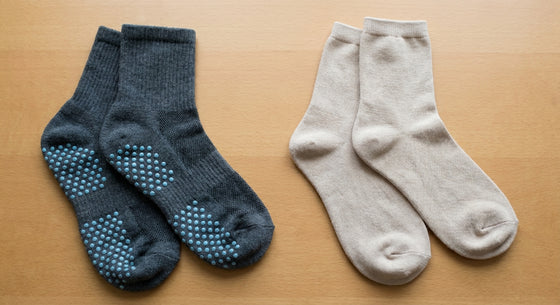
It is also worth clarifying how the grip is built. Silicone pads, printed patterns, and integrated yarn structures can perform differently over time depending on thickness, placement, and quality control.
Quality Checkpoints That Predict Real Performance
No matter where you shop, a few core criteria matter more than packaging claims. Use these checkpoints to evaluate whether a pair is likely to be competition-ready or just feel good for a session or two.
Grip Pattern Placement and Contact Under Pressure
Look for grip coverage that matches your movement demands. Forefoot and heel traction support acceleration and braking, while midfoot grip can help with balance and stability during cuts and lateral shuffles.
Also consider whether the grip elements are likely to maintain contact under load. Some patterns flatten or lose bite when compressed, which can reduce benefits during high-force movements.
Secure Fit Through the Arch and Ankle
Grip only helps if the sock stays anchored. Prioritize a secure arch band and stable ankle fit so the fabric does not twist, bunch, or slide down inside the boot.
If you routinely adjust your socks mid-training, treat that as a performance signal. A sock that migrates changes pressure distribution, which can increase blister risk and reduce consistent foot strike feel.
Materials That Balance Moisture Management and Resilience
High-performance grip socks should manage sweat while staying structurally sound. Look for a fabric blend designed for moisture control and repeated stretching, plus reinforced heel and toe zones for longevity.
Stitching matters more than many athletes realize. Poor seams can rub during longer sessions, especially when combined with heat and moisture, so prioritize clean seam finishing and durable knit density.
Care and Wash Durability
The best grip socks maintain traction after many washes, not just a handful of sessions. Before buying multiples, check care instructions and avoid assumptions that all grip materials tolerate the same heat, detergents, or drying methods.
Key takeaway: durability is not only about the grip. Fit stability, reinforced zones, and seam quality often determine whether a sock performs consistently across a season.
Smart Buying Tips for Athletes and Teams
A repeatable buying process reduces waste and helps you build a reliable rotation. These steps work well for individuals and scale easily for teams.
- Measure against the brand’s size chart: do not rely only on shoe size, especially if you are between sizes or wear different boots across surfaces.
- Buy one test pair first: evaluate grip, cuff comfort, and whether the sock stays anchored through your hardest training session.
- Test in your real setup: assess performance in your typical boots and on your usual surfaces, because traction feels different on turf versus grass and in tight versus roomy boots.
- Track wash performance: after several wash cycles, check whether grip feels slicker and whether the sock has stretched, twisted, or thinned at the heel.
- For teams, standardize early: once you find a model that works, lock in sizing rules and reorder timing to avoid mixed batches across the squad.
Conclusion: Buy for Consistency, Not Just First Impressions
Grip socks can support better stability, cleaner direction changes, and fewer in-shoe slips, but only when they are built for repeated high-intensity use. The best results come from matching grip layout to your sport, prioritizing a secure arch and ankle fit, and choosing materials that hold up through the grind of a season.
When you shop with a plan, you reduce the chance of ending up with socks that feel great once but fail under real training load. Whether you buy direct for selection, through specialty retailers for fit insight, or via team suppliers for logistics, your checklist stays the same: fit, grip placement, durability, and wash resilience.
If you have questions about team ordering, sizing consistency, or performance features to look for, explore where to buy grip socks and share what sport and surfaces you train on in the comments so others can learn from your process.
Grip that’s scientifically proven.
Join 23,197+ athletes. Free worldwide shipping, up to 44% off the latest drop.
Shop grip socks →